On this page
Your team turned on AI caption writing to save time. Six months in, someone is still rewriting almost every draft before it ships.
That is not a prompt problem. It is a starting point problem, and it is worth fixing before your next Hootsuite or Buffer renewal, not after.
Why AI captions need a rewrite almost every time
Most teams assume the fix is a better prompt or a smarter model. If the draft sounds off, ask for something better next time.
That is the wrong diagnosis.
The tool is not confused about grammar or topic. Generic AI writing tools start from what they already know about your industry and whatever you typed into the prompt box. They do not know your Tone of voice, your brand description, or the specific words a client banned two briefs ago. So the output is competent and on topic, but it still reads like someone who has never sat in on your brand review meeting.
The editing that follows is not polish. It is a full rewrite, one caption at a time, across every client account your team manages (and that tax adds up).
What brand voice actually means in a caption
Brand voice is not a vibe. It is a set of specific choices: sentence length, energy, contractions or not, and what the brand would never say out loud.
Most agencies have this documented somewhere: a tone of voice guide, a list of approved phrases, a banned word list from a client brief that took two calls to finalize.
Unfortunately, none of it reaches the AI when your team starts using it to write. The tool has your prompt, but it doesn’t have your brief.
Why prompt-only AI tools start from zero every time
This is an architecture problem and not a quality one. Hootsuite's OwlyWriter and Buffer's AI Assistant both generate captions from a prompt: type something in, get something out. The more detail you add, the better the result, and the more inconsistent that result gets depending on who typed it that day.
Some tools add a tone dial: formal, casual, friendly. That helps a little. It does not tell the AI that your agency writes like a strategic partner and not a content mill, or that one client account never uses the word innovative. Tone is not brand voice, and the gap between the two is exactly what your team is still filling in by hand, one draft at a time.
How a brand kit changes the starting point
The fix is moving brand context out of the prompt and into the foundation the AI starts from.
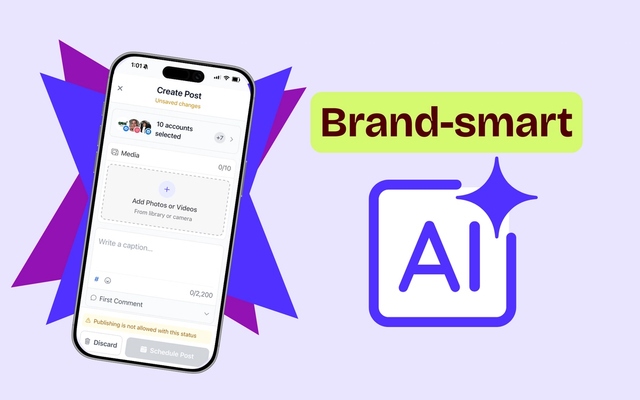
Sked Social's AI caption writing lives inside Create Post. Click the AI icon in the caption box (hover shows "Write with AI") and the model starts from your brand kit: Tone of voice, brand description, and any content labels you have already set. Nothing to re-explain, no prompt engineering required.
From there, refine the draft, translate it, or start fresh with the same input. Every action stays inside Create post, so nothing gets copied between a separate AI tool and your scheduler on the way. The difference is not a smarter model. It is a better-informed one, and it is a large part of why Sked Social sits at 4.6 on G2.
What to look for if brand consistency actually matters
If you manage client accounts with real brand standards, four questions separate the tools that help from the tools that add a step:
- Does it write from a brand profile or a prompt? Prompt-only tools put the work back on your team every time.
- Can you refine without starting over? The first draft is rarely the final one.
- Is the brand context set per account? 15 client accounts should not read like the same brand wearing different logos.
- Does it live inside your scheduler? A caption written somewhere else and pasted in loses context on the way.
Sked Social is built around all four. If brand consistency is a real requirement for your agency and not a line on a pitch deck, it is worth seeing how the brand kit grounding holds up against your own accounts.
Talk to our team and see Sked Social's AI caption writing running on your own client accounts.