You don't build a business. The business builds you.
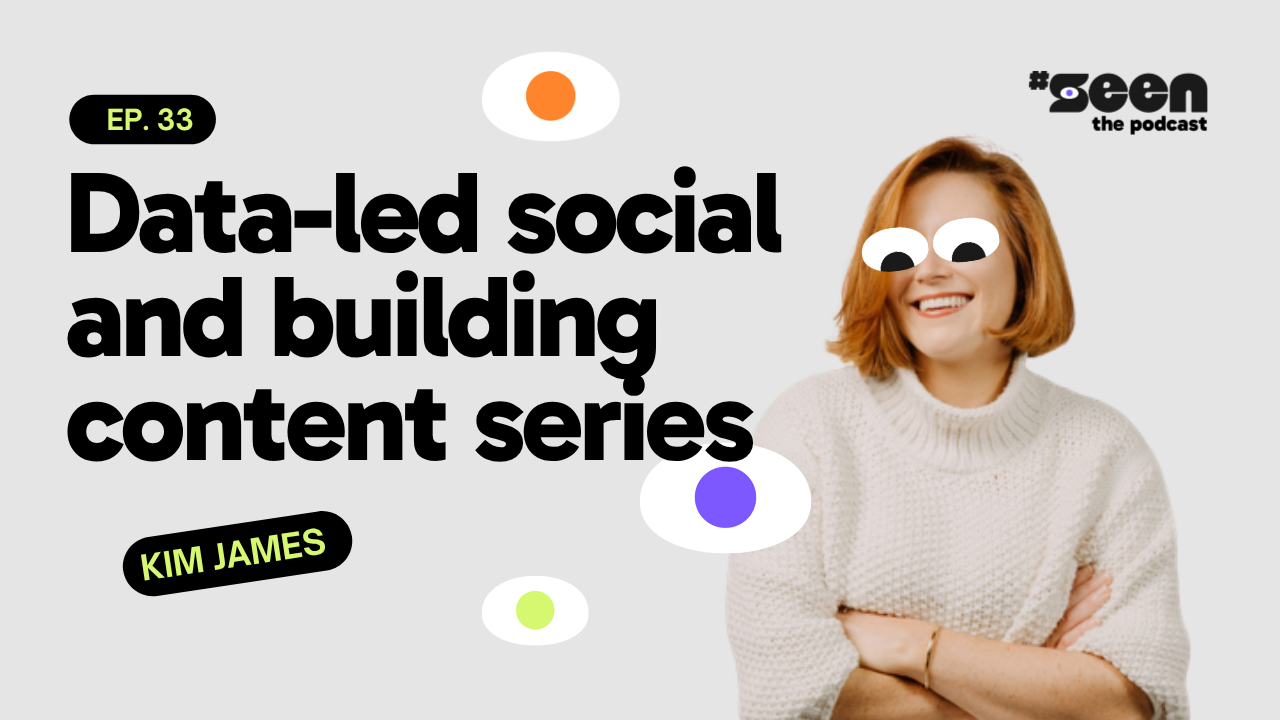
Kim James shares why content series beat random posts, how data grew an account from 42 to 1,600 followers, and why business changes you.
By Lach Bradford · July 15, 2026
I've spent a lot of #seen podcast eps pushing people to post more. More reels, more carousels, more touch points… and most of that is true: Kim James walked me through the seven-plus formats a brand now needs to show up across before anyone buys. But somewhere in our conversation last week I realized I've been handing people the wrong instruction. The volume isn't the point. The volume is the tax you pay for not having the one thing that matters.
There's a name for the thing that matters, and Kim gave it to me almost by accident. She was talking about why she went out on her own, and she said this: you don't build a business, the business builds you into a version of yourself you didn't know you had. I've been turning it over all week. Because it's not really about business. It's about what happens when you commit to one thing long enough for it to change you.
Kim runs Wedge, a data-led creative agency in Melbourne. She came up as a social lead at a plumbing brand ten years ago, pitched the CMO on the idea that social media teams would even be a thing, got told "figure it out, go away," and did. Last year she was building an AI startup and raising funding. She pulled all of it, bought out her co-founder, and rebuilt Wedge as a solo-led agency in eight weeks. What she thinks about social now comes from having torn her own thing down and put it back together, which is a different kind of authority than most agency founders have.
Here's what stuck.
Post more is the wrong instruction. Build one thing you become known for.
Kim's line was that social media is consumption now. People aren't sharing to their own feeds much outside stories: they're consuming, the same way they binge a series on Netflix. So the number-one thing Wedge does for every client is build a content series, not a pile of one-off posts.
"You become known for something. It turns up, it's repeatable, it's recognizable. People don't remember by name. They remember the type of content."
She uses the example of the guy who climbs a ladder and guesses your career from it. You know the videos. You could not name the person if your life depended on it, but you know exactly the kind of thing he makes. That's the goal. Not fame. Recognition of a format.
The proof: Wedge built a series called Hot Girls Buying Houses for a mortgage broker. It took the account from 42 followers to just under 1,600 in five to six weeks, and it put real women on booking calls saying "I didn't know I could buy my own." The series wasn't clever for the sake of it. Kim validated it with data first: close to half of women are projected to be single by 2030, so a series speaking directly to single women buying property wasn't a gamble, it was a bet on a trend the numbers already showed.
Try this week: pick one series you could run for eight weeks straight. Not eight different ideas. One idea, eight episodes. If you can't name what you'd be known for at the end of it, you don't have a series yet, you have a posting schedule.
"That's just gut feel" is usually a formula nobody's written down.
The bit that surprised me most was how unromantic Kim is about creative. People assume the good stuff is instinct. She pushes back hard: there's a formula, and she's specific about it. Video length. Hook type. How many words go on a single carousel slide. Wedge has built these rules into Claude as skills, so the standard travels with the work instead of living in one person's head.
I liked this because it's the opposite of how agencies usually protect themselves. The mystique of "we just have great taste" is a bad moat. A written-down formula that a team can actually run is a better one, and it's the thing that lets you keep quality high while you scale.
Try this week: write down one rule you follow that you've always called instinct. Just one. Word count on a hook, ideal clip length, the shape of a caption. The moment it's on paper, someone else on your team can run it.
Known-for beats niching-down.
Kim had a car-loan client who did not want to niche. Multiple services, didn't want to be "the car loan people." She told them TikTok would be their place and car loans would be the wedge. They resisted. They're now in the top 0.5% for car-loan search on TikTok, and 80% of their business comes from social.
Her framing is the roots of a tree: the roots stay put, and you branch out from there. Being known for one thing isn't a cage. It's the anchor that lets you grow into the next thing without confusing anyone about who you are. Most brands get this backwards. They think being everything to everyone keeps their options open. It just makes them forgettable.
Try this week: finish this sentence for your brand in six words or fewer. "People follow us because we do ___." If you need more than six words, the roots aren't deep enough yet.
One thing I'd push back on, (gently).
Kim is completely data-led, and I mean completely: she pulls a data analysis before she even walks into a strategy session. I love the rigor. But I'd add a caveat she'd probably agree with. Data tells you the trend is real. It does not tell you the series is good. Hot Girls Buying Houses worked because the name was sharp and the promise was human, not because a spreadsheet said single women buy houses. The data de-risked the bet. The craft won it. Keep both. Don't let the dashboard talk you out of a brave idea, and don't let a brave idea skip the check that the audience is actually there.
There's also a harder thread we got into that I won't dress up. Kim burned out in 2021 and it took her two years to recover. What she said about it has stayed with me more than any of the tactics: the fix wasn't doing less, it was giving more to herself outside the work, because the more you give yourself, the more you have to give the work. If you're reading this on a Sunday with your notifications on, that one's for you.
Kim is one of the sharpest agency operators I've had on this year, and the full conversation goes deep on the rebuild, the systems, and the future of social as brands become media companies. It's up on YouTube now. The Hot Girls Buying Houses breakdown is around 17 minutes if you want to skip straight there
- Lach
🎧 Watch the full episode: The content series that took an account from 42 to 1,600 followers.
Let everyone post. Keep every post on-brand.
Schedule, publish, listen and report in one place, with login-free approvals for every stakeholder and client. Try Sked Social free for 14 days, no credit card required.