On this page
- Key takeaways
- How much should an agency charge for social media management in 2026?
- Which social media management pricing models do agencies actually use?
- How to build good-better-best social media management packages
- What actually drives social media management pricing?
- White-label social media management pricing and reselling
- How do you price social media management for multi-location and franchise clients?
- How your management tool protects your agency margin
- Expert tips and common pricing mistakes to avoid in 2026
- Frequently asked questions about agency social media pricing
- Transform your social media management pricing with Sked Social
Key takeaways
- Most agencies price social media management as a monthly retainer. Commonly observed bands run from a few hundred dollars for entry packages to five figures for premium full-service work. Always price from your own cost of delivery, not from a competitor's rate card.
- The global social media management market was valued at about USD 29.9 billion in 2025 and is projected to reach USD 171.6 billion by 2033 at a 24.8% CAGR, so agencies are pricing into a fast-growing category.
- Separate your management fee from ad spend on every proposal. The management fee pays for your team's time and tools. Ad spend is the client's media budget, not your revenue.
- Build good-better-best packages, charge a one-off onboarding fee, and treat your management tool as a deliberate per-client cost line, not an afterthought.
- Fewer revision cycles protect margin. Sked Social's Kanban Approvals Board and no-login client review portal cut email chains so more of every retainer hour turns into billable work.
Pricing is where most agencies quietly leak profit. You can win the client, deliver great work, and still lose money because the package was priced on a guess. This guide gives you the models, the packages, and a repeatable cost-of-delivery framework so your social media management pricing protects your margin instead of eroding it.
How much should an agency charge for social media management in 2026?
Here is the direct answer. An agency should charge from its cost of delivery, not from a fixed rate card. Estimate the monthly labor hours a client needs, multiply by your loaded hourly rate, add tool and content costs, then apply a markup that protects your target margin. In practice that lands most agency retainers somewhere between a few hundred dollars a month for a light entry package and five figures a month for premium full-service work.
If you want directional bands for framing, agencies commonly quote roughly a few hundred to around $1,500 a month for a starter package, low-to-mid thousands for a growth package, and five figures for premium full-service accounts with paid social, video, and heavy community management. Per-post pricing tends to sit anywhere from about $25 to several hundred dollars depending on production, and hourly work often runs in the $50 to $150 range. Treat every one of these as directional only. They are not a benchmark to copy, and you should re-verify current market rates before you quote.
The market context matters because it shapes what clients expect to pay. The global social media management market was valued at about USD 29.9 billion in 2025 and is projected to reach about USD 171.6 billion by 2033, growing at a 24.8% CAGR from 2026 to 2033, according to Grand View Research. Worldwide social media advertising spend is separately projected to reach US$338.75 billion in 2026, according to Statista Market Insights. Demand is rising and budgets are moving, which is good news for pricing power if you package the work well.
This question actually hides two questions. Agencies want to know what to charge. Clients want to know what to pay. The answers meet in the middle, but you set the anchor. One more clarification protects you on every proposal: your management fee is not ad spend. The fee covers your team, your tools, and your expertise. Ad spend is the client's media budget paid to the platforms. Keep them on separate lines so nobody misreads your number. You can capture your own branded demand by pointing prospects to the Sked Social pricing page as a transparent reference point.
Which social media management pricing models do agencies actually use?
Agencies use six core pricing models, and most end up blending two of them: monthly retainer, per-post or à la carte, hourly, project-based, value-based, and hybrid. The monthly retainer is dominant for a reason. Social media work is continuous, the value compounds, and a retainer gives you predictable recurring revenue and a deeper client relationship. Per-post or à la carte pricing works for clients who want a defined output and nothing more. Hourly pricing suits ad-hoc consulting or overflow work. Project-based pricing fits launches, campaigns, and audits with a clear start and finish. Value-based pricing ties your fee to the outcome you create rather than the hours you spend. Hybrid pricing, a base retainer plus add-ons, is where a lot of profitable agencies land.
Here is the head-to-head buyers ask about most.
- Monthly retainer: best for ongoing, always-on social. Pros: predictable recurring revenue and relationship depth. Cons: scope creep if boundaries are loose.
- Per-post or à la carte: best for defined, low-touch output. Pros: simple to quote and buy. Cons: caps your upside and is hard to scale.
- Hourly: best for consulting and overflow. Pros: fair for unpredictable work. Cons: punishes your own efficiency.
- Project-based: best for launches, campaigns, and audits. Pros: clear scope and deadline. Cons: no recurring revenue.
- Value-based: best for outcome-driven engagements. Pros: highest margin potential. Cons: requires trust and clear metrics.
- Hybrid: best for growing agencies. Pros: stable base plus upsell room. Cons: needs disciplined scope tracking.
Retainer versus project-based comes down to whether the work ever really stops. Ongoing publishing, community management, and reporting are continuous, so a retainer matches the shape of the work and smooths your cash flow. Launches and one-off campaigns have a natural end, so a project fee matches that shape instead. Most agencies use both. The catch with any retainer is that it only stays profitable if you can deliver a repeatable production system, not ad-hoc scrambling. A consistent posting cadence built on a visual content calendar and a reliable post queue is what keeps a retainer from turning into unpaid overtime.
How to build good-better-best social media management packages
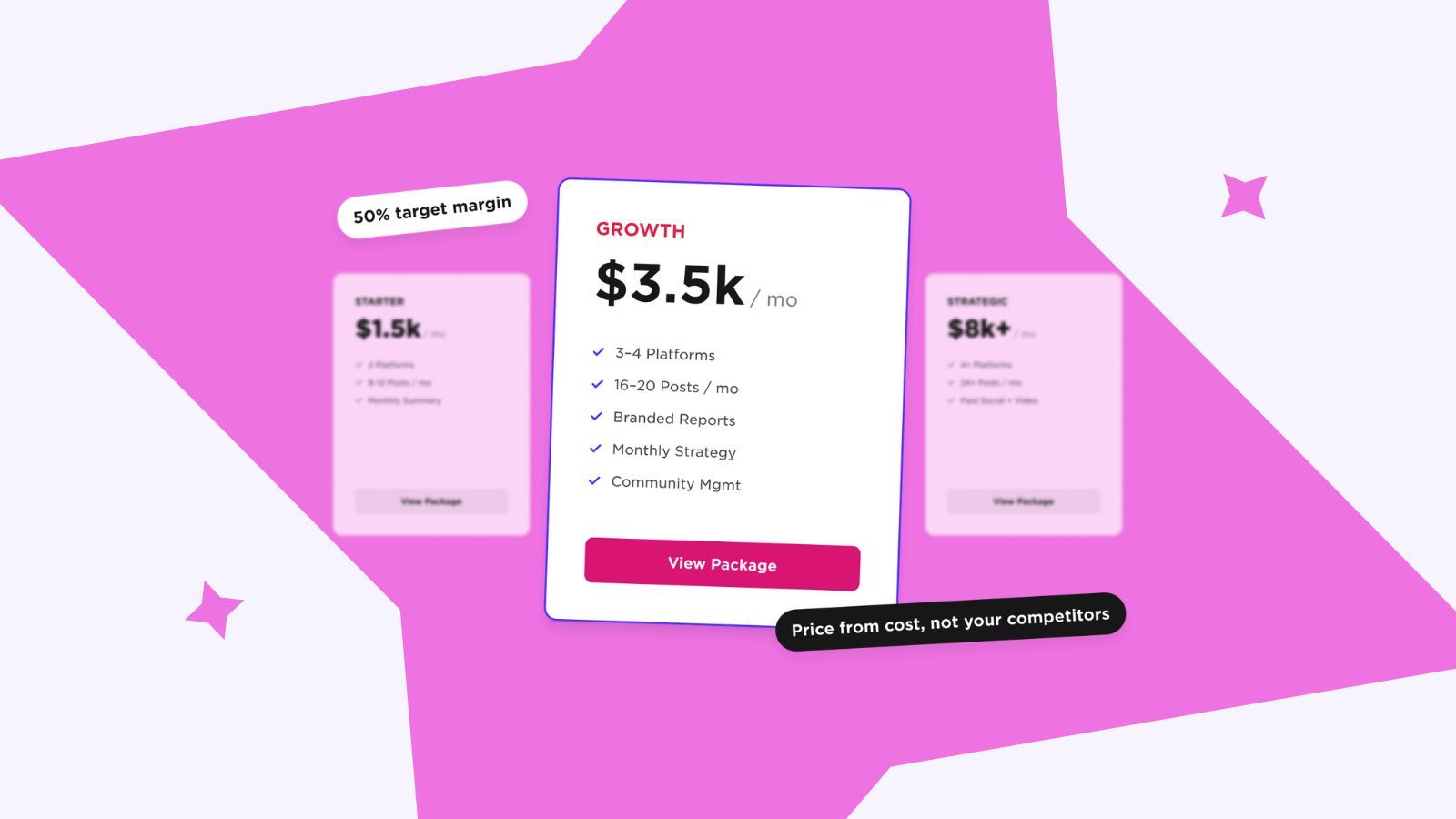
Good-better-best packaging does two things at once. It lets clients self-select, and it anchors them toward the middle tier, which is usually your sweet spot. Give each tier a clear name and a clear jump in value. A simple structure is Starter, Growth, and Strategic.
- Platforms. Starter: 2. Growth: 3 to 4. Strategic: 4 or more.
- Posts per month. Starter: 8 to 12. Growth: 16 to 20. Strategic: 24 or more.
- Community management. Starter: business hours, light. Growth: daily. Strategic: daily, priority response.
- Reporting. Starter: monthly summary. Growth: monthly branded report. Strategic: branded report plus strategy call.
- Strategy. Starter: quarterly check-in. Growth: monthly. Strategic: monthly plus campaign planning.
Take one client through the tiers. A boutique retailer starts on Starter for consistent posting across Instagram and Facebook. Six months in, they want LinkedIn, more posts, and a monthly report they can show their board, so they move to Growth. When they launch a new product line and need campaign planning and paid social, they move to Strategic. Same client, three price points, each justified by real deliverables rather than a vague promise of more effort.
Add-ons are where margin expands. Extra platforms, paid social management, video editing, extra reporting cadence, and influencer coordination all sit naturally on top of a base tier. Price them as clean line items so the upsell is obvious and easy to say yes to. A downloadable price list or package one-pager is worth building as a lead magnet, because buyers want something concrete to compare.
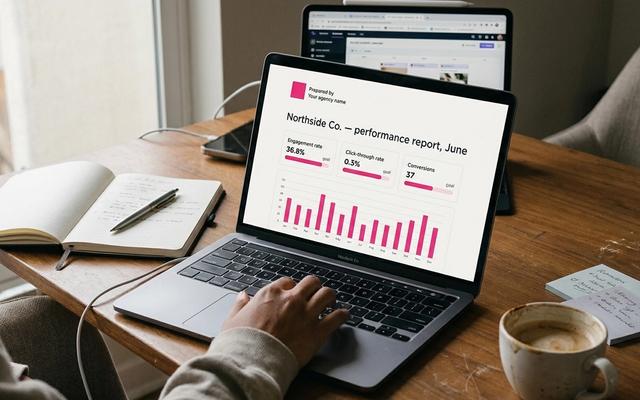
Premium tiers need premium proof. This is where reporting earns its keep. Custom Reports on Sked Social's Accelerate and Custom plans lets you assemble multi-account, multi-platform reports, add your agency or client logo and brand colors, then export to PDF or Excel. You can schedule those reports to generate and send on a recurring basis, so your top tier delivers polished reporting automatically instead of eating a day of someone's month.
What actually drives social media management pricing?
Price follows scope, and scope is made of specific, countable things. The real drivers are the number of platforms and profiles, monthly content volume, whether content is video or static, whether you manage paid ads, community and inbox volume, reporting depth, strategy time, industry complexity, client size, and geography. A regulated healthcare client with three approval layers costs far more to serve than a local cafe with one owner who replies in minutes. Price the difference.
Reporting depth alone can move a quote by hundreds of dollars a month, from a light monthly summary up to a social-first GA4 reporting setup that connects social activity to on-site conversions. Here is a cost-of-delivery worksheet you can reuse for every proposal.
- Estimate monthly labor hours by role. Add up content creation, scheduling, community management, reporting, and account management.
- Apply your loaded hourly rate. This is not just salary. It includes payroll taxes, benefits, software, overhead, and non-billable time. A team member you pay $40 an hour often has a loaded rate closer to $65 to $80.
- Add direct costs. Content production, stock, paid tools, and your management software allocated per client.
- Total the cost of delivery. Labor plus direct costs equals what this client actually costs you to serve.
- Apply your markup. If your cost of delivery is $1,800 and you want a 50% margin, you price at roughly $3,600. Adjust markup by client value and competitive context.
Two more line items complete the picture. First, charge a one-off onboarding or setup fee. Account access, brand immersion, template building, and the first strategy session are real work that happens before a single post goes out, and a setup fee is standard practice that stops month one from running at a loss. Second, remember that ad spend is never inside your management fee. If you run paid campaigns, charge a management fee on top of the spend, either flat or as a percentage of the budget you manage.
Efficiency is a hidden price driver too. Fewer context-switching errors mean fewer wasted hours. Accounts and Groups on Sked Social, available on all plans, organizes profiles into per-client groups that scope your Calendar, Inbox, and Insights to one brand at a time, so you are not posting the wrong content to the wrong account or losing time hunting for the right profile.
White-label social media management pricing and reselling
White-label and reselling are two different plays. White-label means you deliver the work under your own brand while another provider or tool powers part of it behind the scenes. Reselling means you sell another provider's service, mark it up, and manage the client relationship. White-label suits agencies that want to own the client experience and present a consistent brand. Reselling suits agencies that want to add a service line without building the delivery capability in-house.
Both models justify premium pricing when the client-facing output looks and feels like yours. Branded reporting is the clearest example. When a client opens a report with your logo, your colors, and a clean cover page, the perceived value of the retainer rises, and so does retention. A report that looks like an afterthought invites price scrutiny. A report that looks like a strategic document invites renewal. If you are choosing the software that produces those reports, our comparison of the best social media reporting tools breaks down what to look for.
When you mark up white-label or subcontracted work, protect both margin and quality. A common approach is to price the subcontracted cost at your standard markup, then add a management layer for the coordination, quality control, and client communication you own. Never let the markup be the only thing you add. If you are just passing work through, clients eventually notice and go direct. Your value is the strategy, the accountability, and the single point of contact.
Be precise about what you can genuinely white-label. On Sked Social, the concrete basis for white-label delivery is branded reporting. Custom Reports on Accelerate and Custom supports your agency or client logo and brand colors, exported to PDF or Excel. That is a real, ownable client deliverable. Sked Social itself is not a fully white-labeled platform, so scope your white-label claim to branded reporting rather than the whole product. Honest scoping keeps your proposals credible and your renewals clean.
How do you price social media management for multi-location and franchise clients?
Multi-location and franchise clients are one of the most under-priced opportunities in the market, largely because most agencies quote them like a single big account. They are not. The right structure is a base central-management fee plus a per-location add-on. The central fee covers strategy, the master content calendar, brand governance, and network-level reporting. The per-location fee covers local customization, local community management, and location-level reporting. This separates the strategy you sell once from the execution you repeat many times.
Approval complexity is the factor agencies most often forget to charge for. A franchise brand typically needs multi-level sign-off, head office, then regional, then the local operator, and each layer adds coordination time. That extra coordination is a billable premium, not a favor. Price it in.
Here is a hypothetical. A 12-location fitness franchise wants a central content calendar with local customization at each site. You quote a central management fee of $3,000 a month for strategy, the master calendar, brand guardrails, and a rolled-up national report. Then you add $350 per location per month for local scheduling, community management, and a location-level report. 12 locations at $350 is $4,200, for a total of $7,200 a month. That number is defensible because every line maps to real, repeatable work, and the per-location logic scales cleanly as they open new sites.
Delivering this profitably needs the right operational backbone. Accounts and Groups groups profiles by location or region and scopes each view, so a national account stays organized. Approvals, included on Accelerate and Custom, supports custom-named statuses you can map to head office, then regional, then local sign-off for compliance-heavy chains. And Custom Reports can produce both network-level and per-location branded reporting, which is exactly the deliverable that justifies the premium tier.
How your management tool protects your agency margin
Almost no one prices their management tool as a line item, and that is a mistake. Your scheduling and reporting software is a per-client cost, and it is also a per-client efficiency lever. Batch scheduling, a single multi-account hub, and faster reporting cut the delivery hours behind every retainer. Fewer hours at the same price is a higher effective rate. That is the whole game. If you are still comparing platforms, our roundup of the best social media management tools for agencies weighs the trade-offs by agency size.
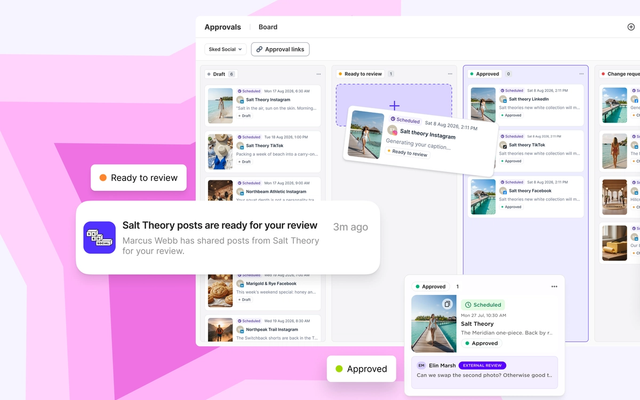
Client-approval friction is the clearest link between tooling and profit. Every extra revision cycle and every buried email thread is unpaid time. Cut the cycles and more of each retainer hour becomes billable margin. Sked Social's Approvals Board is a Kanban view where posts sit as cards you drag between status columns, and clients review and sign off through a branded no-login portal with a full audit trail. No login chases, no version confusion, no lost feedback in email. External notes keep client-facing context separate from internal comments, and automated review reminders nudge slow approvers so your calendar does not stall. For a step-by-step system, see how to build an agency approval process that survives 15 clients.
Seat economics matter too, and here honesty is the policy. Sked Social includes 3 users on the Grow plan and 6 users on the Accelerate plan within the plan price. On Accelerate you can add more users at US$15 a month each (US$150 a year on annual billing), and Custom is sized to larger teams by contract. The point is not that seats are free. The point is that predictable per-plan pricing makes your own cost of delivery easier to forecast, which makes your client pricing steadier.
Run the math on one client. Say the tool saves your team eight hours a month on that account through batch scheduling, a single hub, and automated reporting. At a loaded rate of $70 an hour, that is $560 of recovered capacity every month, far more than the per-client cost of the software. Recovered hours either drop to your bottom line or free your team to take on another account. Either way, the tool pays for itself and then protects the margin on everything else.
Expert tips and common pricing mistakes to avoid in 2026
The agencies that price well tend to follow the same handful of habits. Start with these tips, then watch for the mistakes that quietly kill margin.
Do these things. Price from cost, not from what a competitor charges, because you do not know their cost structure. Always quote a middle tier as your default recommendation so clients anchor there. Put ad spend on its own line, every time. Charge a setup fee so month one is profitable. Review pricing on every renewal, because your costs rise even when your rates do not. Track scope in writing so you can see creep before it becomes unpaid work.
Avoid these mistakes. The first is under-charging for approvals and compliance. Multi-layer sign-off is real labor, and clients who need it will pay for it if you show them the process. The second is ignoring tool cost. If software is invisible in your pricing, it silently eats margin across every account. The third is pricing per-post when the client actually wants outcomes, which caps your upside and turns you into a vending machine. The fourth is letting scope creep go unnamed. One extra platform, one more report, one weekly call, and suddenly your effective rate has halved. The fifth is copying a public rate card without doing your own cost math, which is how agencies win clients and lose money at the same time.
One more habit separates profitable agencies from busy ones. They treat pricing as a system, not a one-time decision. They build packages, they build a cost worksheet, they build a reporting deliverable that justifies the premium, and they revisit all three regularly. Pricing is not a number you set once. It is a discipline you run every quarter, and the agencies that run it well are the ones still standing when budgets tighten.
Frequently asked questions about agency social media pricing
How much do agencies charge for social media management in 2026?
Most agency retainers fall between a few hundred dollars a month for a light starter package and five figures a month for premium full-service accounts, with growth packages in the low-to-mid thousands. Per-post work commonly runs from about $25 to several hundred dollars, and hourly rates sit around $50 to $150. Treat these as directional and price from your own cost of delivery.
What is the difference between a management fee and ad spend?
Your management fee pays for your team's time, tools, and expertise. Ad spend is the client's media budget paid directly to the platforms. They are not the same money and should never be combined on a proposal. If you run paid campaigns, charge a management fee on top of the spend, either as a flat fee or a percentage of the budget you manage.
How do you price social media management for multiple locations or franchises?
Use a base central-management fee plus a per-location add-on. The central fee covers strategy, the master calendar, brand governance, and network-level reporting. The per-location fee covers local customization, community management, and location-level reporting. For example, a $3,000 central fee plus $350 per location across 12 sites totals $7,200 a month, and it scales cleanly as new locations open.
Should agencies charge retainers or use project-based pricing?
Use a retainer for continuous work like ongoing publishing, community management, and reporting, because it matches the shape of the work and smooths cash flow. Use project-based pricing for launches, campaigns, and audits that have a clear start and finish. Most profitable agencies use both, often as a hybrid of a base retainer plus project or add-on line items.
What profit margin should an agency target on social media management?
A common target is a 50% gross margin after the full cost of delivery, which includes loaded labor, content production, and your management software allocated per client. Build the quote from that cost base, add a setup fee so month one is profitable, and adjust the markup by client value and competitive context rather than copying a public rate card.
Transform your social media management pricing with Sked Social
Profitable pricing is not a spreadsheet trick. It is what happens when your delivery is efficient, your reporting looks premium, and your approvals stop leaking hours into email. That is exactly where Sked Social fits. It is the social media workspace for growing agencies, from first idea to final report, in one place instead of five.
The pains this guide covered map directly to features. Scope creep and wasted hours are answered by Accounts and Groups and a repeatable publishing system. Approval friction is answered by the Approvals Board and no-login client portal, so fewer revision cycles turn into more billable margin. Premium and white-label tiers are justified by branded Custom Reports your clients receive as PDF on your schedule. And multi-location clients get the per-location structure and rolled-up reporting that lets you price them properly.
Support is real humans, at no extra charge, with a 94% CSAT rating. Fair pricing is not a feature. It is just how Sked Social operates, and it makes your own pricing easier to build on.
Ready to transform your social media pricing? Start your free trial today. No credit card required.