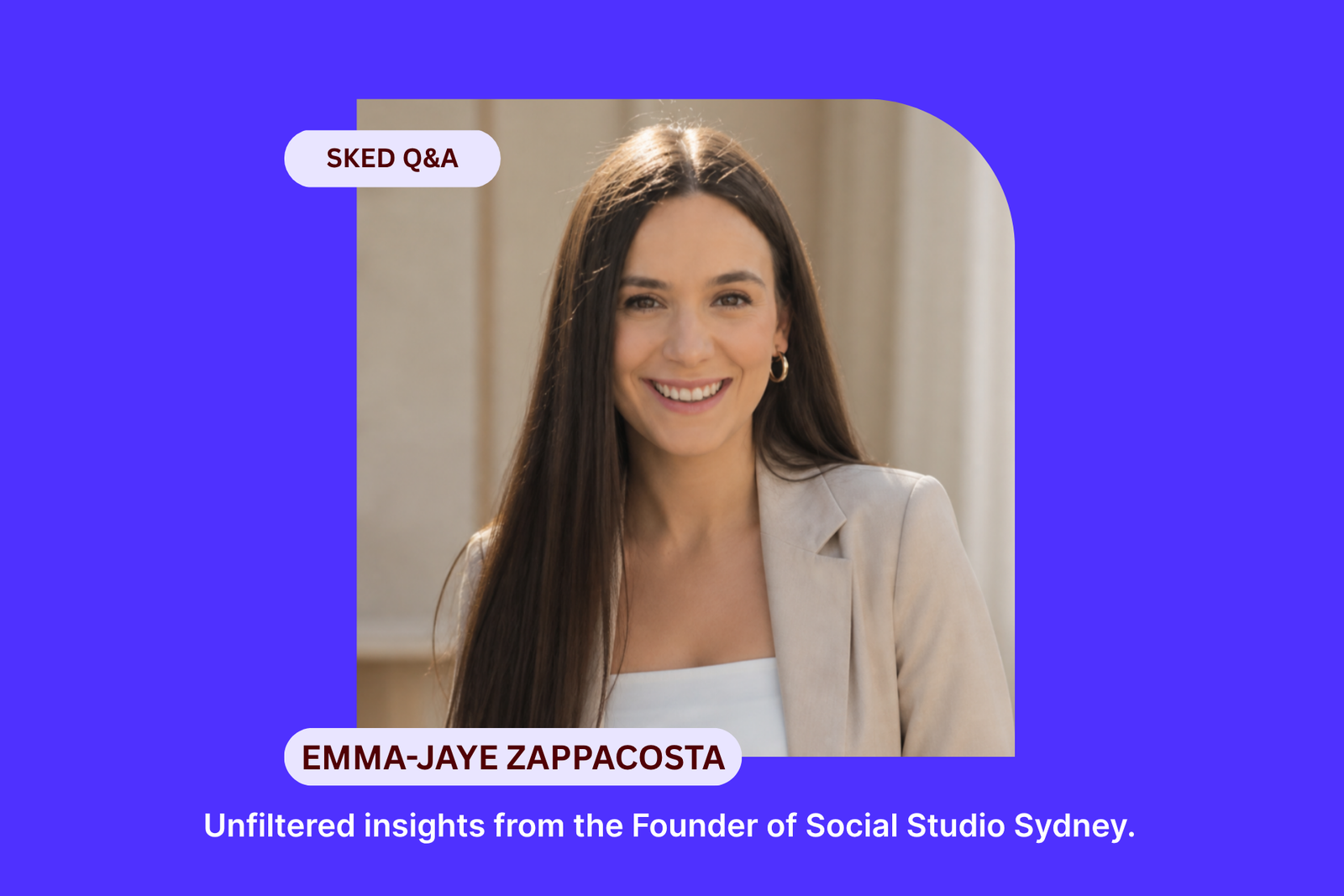
Emma-Jaye Zappacosta understands something a lot of brands still miss about social media: posting isn’t the job anymore. Connection is. As Head of Social, she’s built her approach around conversation, consistency, and creating content that actually sounds like a real person made it. In this Q&A, Emma breaks down why comment sections matter more than ever, why most brands confuse activity with strategy, and how some of the best-performing content starts by simply showing the humans behind the business
1. What’s one social strategy you’ve doubled down on this year that’s actually moved the needle?
Genuinely investing in the comment section as a deliberate and considered part of social media management. For years, I've seen clients treat posting as the finish line, crafting content, hitting publish and moving on to the next. These days, that's not enough. We've made community management and social listening a non-negotiable, replying, asking follow-up questions, and pulling people into actual conversations. Not only has the algorithm noticed, but our audiences have definitely noticed.There's a version of social media that's a broadcast tower, and there's a version that's a two-way street. Plus, it's where some of the best content ideas come from - direct from your audience.
2. Walk us through your best performing post. What was the idea, why did it work, and how did you know it hit?
The best performing post we've developed lately was actually our simplest... showcasing the people behind the business - the personalities, faces and teams of the people that bring a business to life. Working alongside an FMCG business who is a figment of Sydney's Inner West and Eastern Suburb communities, we produced a content series that leveraged the owner and their dedicated team to highlight the real heart of the business through conversation, action and humour. Across the four-part series, we achieved thousands of views in a matter of minutes, and engagement rates in excess of 10% per video, championing the team that make the business thrive.
3. What’s a mistake you see brands making on socials right now that’s quietly killing reach or engagement?
Inconsistency dressed up as strategy. Showing up sporadically, pivoting every few weeks, chasing whatever format just worked for someone else, and calling it "being agile". It's not agile. It's the absence of a point of view. Audiences are remarkably forgiving about a lot of things, but they don't forgive not knowing what you stand for. When your content has no consistent thread, no voice, no perspective, no reason someone would know it was yours without a logo, you're not building an audience, you're just generating content. here's a real difference between the two and not enough brands are honest with themselves about which one they're actually doing.
4. What’s the metric you care about most and why?
Engagement rate, but not in the form of likes. In the form of written interactions. A comment takes actual effort, and a DM, even more. Someone felt strongly enough to take the conversation somewhere private. When those two numbers move, I know something genuinely connected. Everything else is honestly just the audience being polite. It's a quick scroll and a double tap. Comments and DMs are where you find out if you actually said something that mattered.
5. What’s the best piece of advice you’ve ever been given about content or creativity?
Make it for one person, not for everyone. As a junior, starting out when Facebook was restricted to text posts and video was only available on YouTube, this always felt counterintuitive. But (well over) a decade down the track, it's the blueprint for successful content. The more specific you are, the more universally it lands. When you're writing for an actual, imaginable human with a real problem or a real perspective, the specificity makes it feel true, and truth travels. Vague content chases everyone and catches no one, and with content fatigue at an all time high, an audience of one is better than none.
6. What’s the worst advice you followed for way too long?
That we needed to move at "the speed of culture". If I had a dollar for every time I heard that phrase, I'd be retired.If you're only posting content around trends, you're always going to be behind. By the time something is recognisably a trend, the moment has already passed. You're showing up to a party to tell everyone what a great time it was. The brands that actually shape culture aren't chasing it. They have a strong enough point of view that culture occasionally comes to them. Content should build distinctiveness, not be optimised for relevance.
7. What book, album, podcast, or creator has quietly shaped how you think about your work?
There's a way Mark Ronson talks about making records that I keep coming back to. The idea that a great producer isn't just technically skilled, they're obsessively curious. They'll pull in a sample from somewhere completely unexpected, sit with it, build around it, tear it down, rebuild it again. The whole process is experiment, listen, adjust, repeat. And they don't stop until it's right... not deadline-right, actually right. That approach to craft quietly shaped how I think about strategy. Social media has this relentless pressure to produce and publish and move on. But the best campaigns I've worked on had that same producer energy underneath them, with a willingness to keep refining until something clicks, and the patience to know the difference between done and finished.
8. What’s a habit or rule in your workflow that keeps you sane and consistent?
A daily to-do list, written with pen on paper, every working day. Ironic for someone who specialises in social and digital, but this analogue behaviour helps me align my priorities without the distraction of anything else, and at the end of the day I can visibly see everything that I have achieved, and everything else that can be a tomorrow problem.
9. If you had to explain your content strategy to a non-marketer in one sentence, what would you say?
We show up consistently, say something worth hearing, and make it easy for the right people to find us, then we listen harder than we talk.
10. What’s something about working in socials that doesn’t get talked about enough?
That everyone thinks they're an expert because they have an account. Over a decade in this industry and the hardest part of my job has never been the algorithm or the content or the clients... it's the credibility gap. And I get it. It's an intimate medium, it lives on your phone, it feels personal and intuitive. But using a platform as a consumer and building strategy on one professionally are about as related as enjoying a meal and running a restaurant. I've sat in rooms with executives who've never run a campaign, never read an insight report, never tested a hypothesis, and watched them override months of thinking because something "felt off." That doesn't happen in finance. It doesn't happen in engineering. It's the thing nobody warns you about when you get into this industry, and the thing nobody really talks about once you're in it.