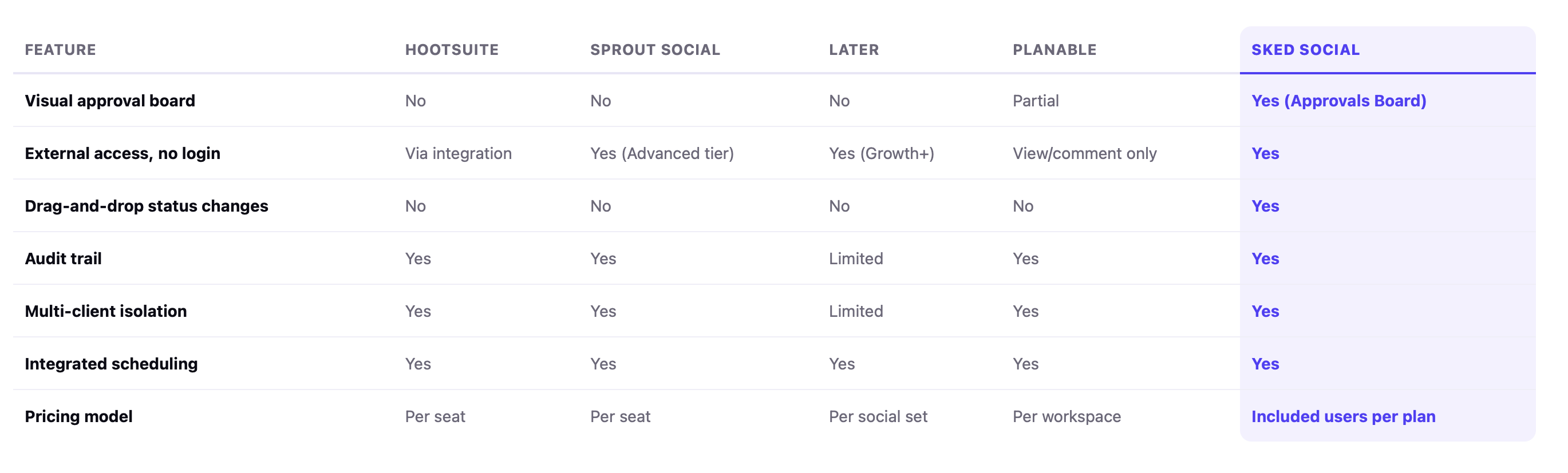
External client access without a login is now common across the main tools; a visual approval board you can act on at a glance is not. That gap is what separates a tool built for agency volume from one that just has an approvals checkbox.
The right question isn't "which tool has approvals?" It's "which tool was built for the way agencies actually work at volume?"
The approval process is where most agency client relationships quietly fall apart. Not dramatically, but in the way where posts go live with last month's pricing, nobody can find the thread where the client said yes, and your account manager is playing detective at 9am on Monday.
For agencies under five clients, almost any tool can hold it together. The trouble starts later, quietly, when the volume of clients crosses a line and the email threads, the screenshots, and the "looks good!" replies stop being charming and start being a liability. This is a guide to picking a tool that survives that line, so you can build an approvals process that does too.
Why approval delays get expensive at scale
There's a direct line between a broken approval process and your agency's ability to operate at scale. It's not just the frustration -- it's the compounding cost of time spent on things that shouldn't take time.
When posts are waiting for approval in email threads and WhatsApp messages, account managers spend hours chasing clients instead of thinking strategically. When there's no central view of what's pending, team leads can't prioritize. When there's no audit trail, you spend time reconstructing history instead of moving forward. When approved content lives in a different tool from your scheduler, every post has a manual handoff.
62.1% of marketing teams already use six or more tools, according to the 2025 State of the Marketing Technology Stack report from MarTech. Adding yet another standalone approval tool compounds the problem: more context switching, more logins, more places for things to fall through.
The agencies that run clean at 15 clients aren't trying harder. They've built a process that removes friction at every step: one place to review, one link for clients to click, one view to understand where everything stands.
That's not process optimization for its own sake. It's a structural decision about which tools belong in your stack.
What to look for when evaluating approval tools
Before you commit to any tool, test it against these eight criteria:
Client access without a login. Non-negotiable. Test it yourself: can a client click a link and review a post without signing up for anything
Visual post preview. Does the reviewer see the actual post, image, caption, format, not just a title or description?
A pipeline view across all clients. Can you see every pending post across all client accounts from a single view? Is the status of each post immediately obvious without clicking into each one?
Drag-and-drop status changes. Being able to move a card from "pending review" to "approved" in a single drag is faster and more intuitive than navigating into each post and clicking a dropdown.
Audit trail with timestamps. Does the tool log who approved what, and when? Can you reference this if there's a dispute?
Multi-account management. Can you manage multiple client accounts cleanly from a single dashboard, with clear separation between them?
Integrated scheduling. Is approvals and scheduling the same tool? Or will you be exporting approved content somewhere else?
8. Permissions and access control. Can you assign different access levels to team members, set up specific reviewers per client, and control what each person can see and do?
Not every tool will score well on all eight. Where you're willing to make trade-offs depends on your agency setup, but external client access and a visual pipeline view are the two that matter most at volume.
Join the #seen Community
Join social media managers, marketers, creators and in-house teams sharing what works right now: practical advice, honest conversations, and direct access to some of the smartest people in social.
The three types of approval tools (and their trade-offs)
Most tools in this space fall into one of three categories. Knowing which type you're evaluating changes how you assess the trade-offs.
Type 1: Full social media platforms with approval built in. Tools like Sked Social, Hootsuite, and Sprout Social are complete scheduling and analytics platforms that include an approval process. The advantage: everything is in one place. Approved content flows directly into the scheduling queue without any manual handoff. The risk: approval UX is sometimes an afterthought on platforms built primarily around scheduling and publishing.
Type 2: Approval-first collaboration tools. Tools like Planable are designed specifically around content review and approval. They often have excellent visual interfaces and external reviewer access baked into the core product, and they schedule and publish too. The trade-off shows up around the edges: the wider stack most agencies need (analytics, a unified inbox, social listening) tends to be a paid add-on or simply absent, so you end up topping up with other tools anyway.
Type 3: General project management tools adapted for content approvals. Some agencies use Trello, Asana, or Notion to manage content approval. It works, roughly, until it doesn't. These tools weren't built for social media post previews or external client reviewer access, and the gaps show clearly when you're managing volume across 10+ clients.
For most agencies managing 10 or more clients, the real choice is between Type 1 and Type 2: a platform built scheduling-first with approvals added, or one built approval-first with a lighter wider stack. Both can publish. The question is which gaps you can live with.
The argument for a fully integrated platform compounds over time. Approvals, scheduling, analytics, and inbox in one place means no topping up with extra tools and no content copied between them. If your reviewing, publishing, and reporting all live together, the difference adds up across 40 posts a week.
How the main tools compare
Hootsuite: Approvals exist on the Advanced, Business, and Enterprise plans, with multi-tier reviewers and an exportable approval history. There's no visual pipeline, though, and getting clients to approve without a Hootsuite login generally means wiring up a third-party tool rather than a built-in portal. Per-seat pricing scales quickly for growing agency teams.
Sprout Social: A properly built approval process with role-based permissions and solid audit logging. It does offer no-login external approval, where clients verify an email and sign off without an account, but only on its top Advanced tier. Combined with per-seat pricing that starts high, a 10-person agency across 20+ client accounts adds up fast.
Later: Built primarily for visual content planning, and good at it. It has added external content approval on its Growth plan and up, with a share link that needs no Later account. What it isn't is a volume-first agency system: review is link-and-comment rather than a board you run across many clients, and pricing scales per social set as you add brands.
Planable: Purpose-built for content collaboration and review, with strong visual post previews, comment threads per post, and scheduling and publishing to nine platforms. One detail catches agencies out: guest links let outside people view and comment without a login, but to actually approve, a client has to be invited as a member and log in (the account is free, but it is still an account). Beyond that, analytics and a unified inbox are paid add-ons, there's no social listening on any plan, and pricing is per workspace with one workspace recommended per client -- so the bill climbs with every account you add.
Sked Social: The only one here with a visual, drag-to-approve board (the new Approvals Board), alongside integrated scheduling and a complete audit trail. It offers no-login client approval too, built in from Accelerate and available as an add-on on Grow, rather than locked to a top tier the way Sprout's is. Accelerate is a flat $199 a month whatever your client count, where a five-client setup on Planable's mid plan lands around $335 once you add the analytics and inbox Sked already includes. Available on Grow and above.
How Sked Social handles approvals in 2026
Sked's approach to approvals is built around the idea that the approval process shouldn't feel like admin. The newest addition to that is the Approvals Board, launched in June 2026, and it changes how the whole process feels.
When you navigate to Approvals in Sked, posts appear as cards, grouped into columns by approval stage. At a glance, you can see everything across all your accounts: what's waiting for initial review, what's been sent back for changes, what's approved and ready to publish.
From the board, you can drag a card from one column to the next to update its status. A post moves from "pending review" to "approved" in a single drag. Click a card to see a full preview of the post: image, caption, formatting, exactly as it'll look when it publishes. Right-click for a quick-action context menu. Columns collapse when you've cleared a stage, so you can fold them up and focus on what still needs attention.
The old experience forced reviewers to scan a flat list row by row and mentally group posts by status. The Board makes the approval pipeline immediately legible and every action one step away. It's built for teams managing high volumes of content across multiple accounts, the kind of setup where an inbox-zero approach to approvals is actually achievable.
The Board is the default view when you navigate to Approvals, but Sked hasn't removed anything. The List view, Table view, and Calendar view are all still accessible via the view switcher -- for teams who prefer a different format for specific tasks.
For client collaboration: Sked's external approval portal gives clients a direct link to review and approve content without creating an account. No signup friction on their end. The audit trail captures timestamps and actions, so you always know who approved what and when.
On plan availability: the Approvals feature is available on Grow and above. Grow includes three users; Accelerate includes six. The Approvals Board is included across all plans with Approvals access, no additional cost.
For agencies managing multiple client accounts, the integrated approach matters: approval and scheduling live in the same platform, so there's no handoff between approval tool and publishing tool.
Most agencies spend months in the wrong tool and assume the process is the problem. Usually it's the other way around. Now that the tool question is settled, the process is where the real work starts and where most agencies find out whether they're actually built to scale.
Try Sked Social free for 14 days!
Sked's tools are designed to streamline your workflow, enhance team collaboration, and deliver exceptional results for you and your team.
Our blog, Instagram Trends & Memes, is your one-stop shop for all the latest buzz on the platform. Sign up below to receive regular updates straight to your mailbox.
What to read next
Fill your content calendar—and your inspiration board.


.png)